














































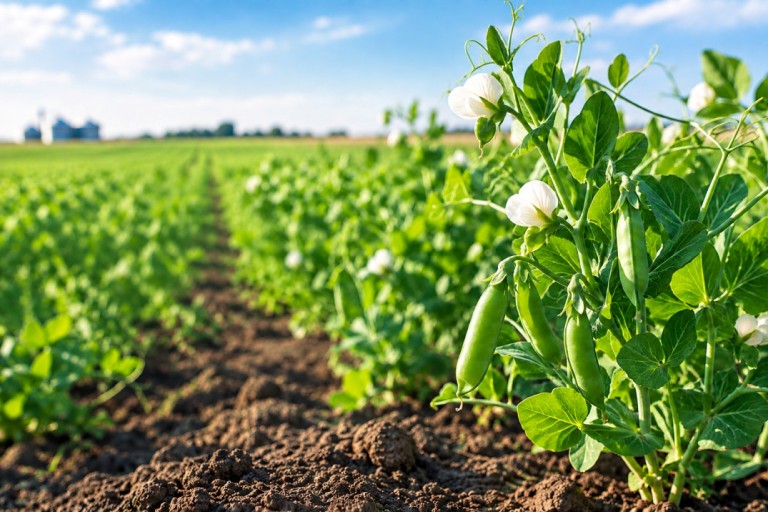
Pulse rotations offer many benefits to Canadian farmers. Understanding effective herbicides and potential risks in an important step in maximizing pulse production. Choosing herbicide for a field peas program doesn’t have to be complicated, but understanding what was applied in previous seasons, and whether any of it is likely to still be present in the soil, is a question that deserves attention before seed goes in the ground.
Herbicide carryover is often treated as a blanket concern, something to be broadly cautious about whenever a rotation change is being considered. But carryover risk isn’t uniform across herbicide groups, and when it’s treated as though it is, unnecessarily conservative decisions can be made in some cases and, more dangerously, real risk can be overlooked in others.
How Crop Protection Products in Canada Are Evaluated for Carryover
Whether a crop protection product has the potential to carry over into the next season depends on several factors. The active ingredient, weather conditions and soil characteristics can all affect how long a product remains active after application. The crop you’re planning to seed next matters too, since some rotational crops are more sensitive to certain active ingredients than others. Refer to product labels or your local retailer to ensure that you are aware of all factors that play into potential carryover.
This is why a blanket rule about carryover rarely holds up under closer examination. A specific field’s history is more relevant than any general assumption about a product category.
Where Field Peas Tend to Be Tolerant
Field peas are generally considered more forgiving than other pulse crops when it comes to certain herbicide residues. Imidazolinone herbicides, a subset of the Group 2 family, are among those that field peas are known to tolerate reasonably well. This tolerance is part of why field peas can be well suited to rotations that have included certain cereal programs or clearfield canola, without carryover becoming a significant concern.
Even with herbicides that field peas are known to handle, soil conditions and residue levels still need to be factored in. Tolerance thresholds can be narrowed when growing conditions are less than ideal.
Where the Real Risk Lives
The more important conversation for growers planning a field pea rotation is around the Group 2 herbicides used in cereal programs that field peas are not tolerant of. These products, when applied in seasons with below-average rainfall or in fields with low organic matter, are known to persist in the soil longer than would be seen under more favorable breakdown conditions.
Microbial activity is slowed in dry soils, and it’s that activity that is responsible for breaking down certain herbicides over time. In fields where organic matter levels are low, the soil’s capacity to bind and buffer residues is also reduced. When both of those conditions are present, an environment is created where carryover is more likely and where the risk to a sensitive crop like field peas becomes more meaningful.
Fields in drier growing zones are particularly worth scrutinizing before field peas are added to the rotation.
Why Record Keeping Changes the Conversation
Detailed field records are one of the most practical tools available when carryover questions need to be worked through. When the product name, application date, rate and the season’s rainfall pattern are on file, a much more informed conversation can be had with an agronomist about whether residue is a realistic concern for the planned crop.
Without those records, the assessment becomes more conservative by necessity. Agronomists working with incomplete information have to account for the possibility that a higher-risk product was used, which can result in recommendations that are more cautious than the actual situation warrants.
Record keeping doesn’t require a complicated system, but consistency is what makes it useful. The fields where the value of that habit is most apparent are often the ones where a rotation change is being considered several seasons down the line.
Field peas can be a strong fit in many rotations, and herbicide carryover doesn’t have to be an obstacle to including them. What is required is an informed look at the field’s history, an understanding of which residues are a genuine concern, which are not, and a willingness to consult with an agronomist when the picture isn’t entirely clear.